What Is a Turnbuckle Tensioner?
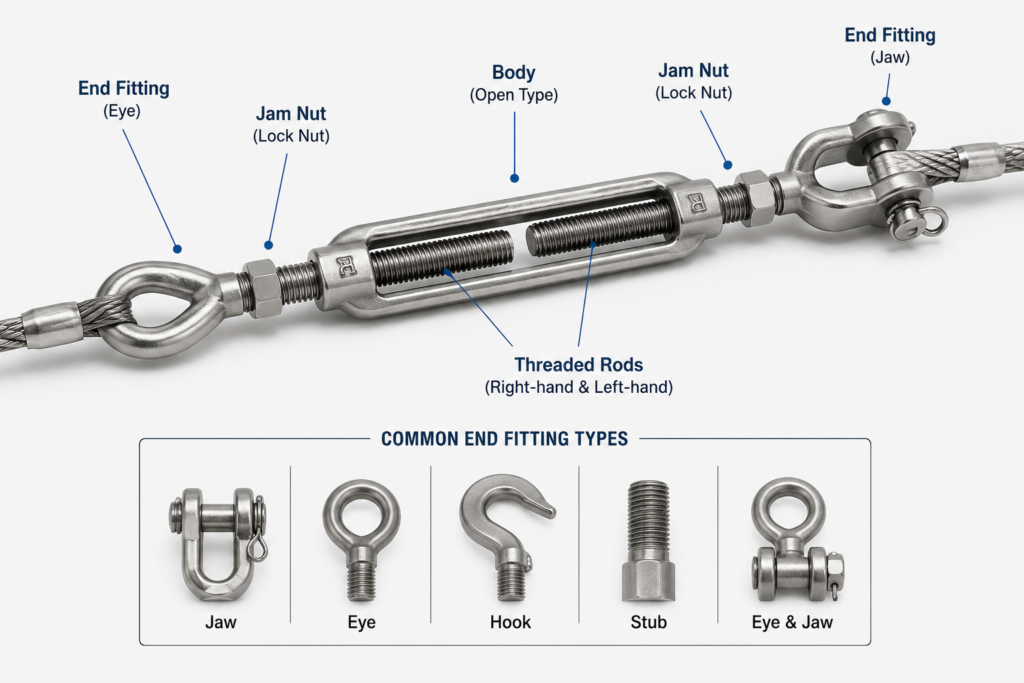
A turnbuckle tensioner is a mechanical device used to adjust tension or length in cables, ropes, tie rods, and other tensioning systems. At its core, it consists of a metal frame with two threaded end fittings—one with a right-hand thread and one with a left-hand thread—connected by a central body. Rotating the body pulls both end fittings inward or pushes them outward, allowing precise tension adjustment without disconnecting the assembly.
Unlike fixed-length connectors, a turnbuckle tensioner gives rigging professionals and structural engineers incremental control over line tension. This makes it indispensable in applications where exact tension values affect safety, structural integrity, or operational performance.
How Turnbuckle Tensioners Work
The working principle is elegantly simple: a turnbuckle tensioner uses opposing screw threads to convert rotational motion into linear tension or compression. When you rotate the central body clockwise, both end fittings are drawn inward, increasing tension on the attached cables or rods. Counterclockwise rotation pushes the fittings outward, releasing tension.
Most industrial turnbuckle tensioners include jam nuts (lock nuts) on each end fitting. After the desired tension is set, these jam nuts are tightened against the central body to prevent unintentional rotation caused by vibration, thermal expansion, or dynamic loads. This locking mechanism is a critical safety feature in structural and lifting applications.
Common Types of Turnbuckle Tensioners
Turnbuckle tensioners are classified by their end fitting combinations. Each type serves different rigging requirements:
- Jaw & Jaw Turnbuckle Tensioner — Both ends have jaw fittings with clevis pins and cotter pins. Easy to install and disconnect. Common in temporary rigging, scaffolding, and stage equipment.
- Eye & Eye Turnbuckle Tensioner — Both ends have closed eye loops. Designed for permanent or semi-permanent connections where disassembly is minimal. Used in cable railing, architectural tension systems, and fence bracing.
- Hook & Eye Turnbuckle Tensioner — One hook end for quick attachment, one eye end for secure fastening. Ideal for applications requiring frequent adjustment or repositioning, such as temporary barrier cables.
- Stub & Stub Turnbuckle Tensioner — Both ends have threaded stub connectors, designed to be welded or threaded into other components. Used in custom fabricated assemblies and OEM equipment.
- Jaw & Eye Turnbuckle Tensioner — One jaw end and one eye end. Provides versatility: jaw side for easy attachment, eye side for permanent anchoring.
Key Specifications for Selecting a Turnbuckle Tensioner
When sourcing turnbuckle tensioners for industrial applications, procurement engineers and project planners should evaluate the following specifications:
Working Load Limit (WLL)
The WLL is the maximum load a turnbuckle tensioner is rated to handle under normal operating conditions. It is a fraction of the minimum breaking strength, typically with a safety factor of 5:1 or 6:1 for rigging applications. Always select a turnbuckle with a WLL that exceeds your maximum anticipated load—never choose based on breaking strength alone.
Material and Finish
Material selection depends on the operating environment:
| Material | Typical Finish | Best For |
|---|---|---|
| Forged Carbon Steel | Hot-dip galvanized | General rigging, construction, outdoor structural |
| Stainless Steel 304 | Electropolished | Marine, food processing, chemical environments |
| Stainless Steel 316 | Passivated | Offshore, coastal, high-corrosion environments |
| Alloy Steel | Painted or zinc-plated | Heavy lifting, high-load industrial applications |
| Malleable Iron | Electro-galvanized | Light-duty, general purpose, cost-sensitive projects |
Thread Size and Take-Up Length
Turnbuckle tensioners are specified by thread diameter (e.g., M12, 1/2″, 3/4″) and take-up length—the range of adjustment the turnbuckle provides. A turnbuckle with a 6-inch take-up can adjust total assembly length by up to 6 inches. Ensure the take-up range matches your installation’s tensioning requirements.
Standards Compliance
Industrial turnbuckle tensioners should comply with relevant standards such as ASTM F1145 (standard specification for turnbuckles), ASME B30.26 (rigging hardware), or EN 13889 (forged steel shackles and turnbuckles for general lifting). Always verify certification with your supplier before procurement.
Industrial Applications of Turnbuckle Tensioners
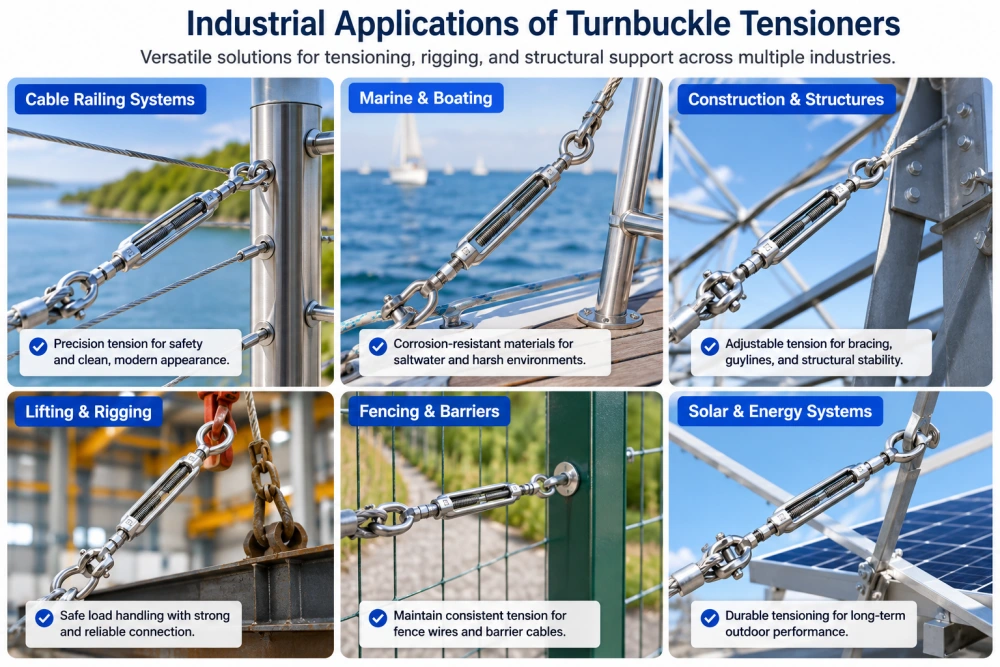
- Structural Bracing — Turnbuckle tensioners are used in cross-bracing systems for steel-frame buildings, bridges, and towers. They apply controlled tension to tie rods, maintaining structural rigidity against wind and seismic loads.
- Marine and Offshore Rigging — On ships, docks, and offshore platforms, stainless steel turnbuckle tensioners secure lifelines, guardrails, and mooring lines while resisting saltwater corrosion.
- Power Transmission Lines — Guy wire assemblies use heavy-duty turnbuckle tensioners to anchor utility poles and transmission towers, maintaining proper cable tension under varying thermal and wind conditions.
- Construction and Scaffolding — Temporary structures and scaffolding rely on turnbuckle tensioners for adjustable bracing, ensuring worker safety during building erection and repair work.
- Architectural Cable Systems — Cable railing, tensioned canopies, and modern architectural features use stainless steel eye & eye turnbuckle tensioners for a clean, adjustable connection.
- Agricultural and Fencing — Turnbuckle tensioners maintain wire fence tension over long distances, compensating for thermal expansion and animal pressure.
Installation and Safety Best Practices
- Inspect Before Use — Check for bent threads, cracked end fittings, and corrosion. Never use a damaged turnbuckle tensioner.
- Ensure Full Thread Engagement — Both end fittings should be threaded into the body by at least the full diameter of the thread. Partial engagement risks thread stripping under load.
- Align the Assembly — The turnbuckle tensioner, cables, and anchor points should be in a straight line. Off-axis loading significantly reduces WLL and causes premature wear.
- Lock Jam Nuts Securely — After tensioning, tighten both jam nuts firmly against the central body. For critical applications, use a second jam nut or thread-locking compound.
- Do Not Exceed WLL — The WLL is not a suggestion. Overloading can cause catastrophic failure. Account for dynamic loads, shock loads, and environmental factors.
- Regular Re-Inspection — In dynamic environments, check turnbuckle tensioners periodically for loosening, wear, or deformation. Re-tension and re-lock as needed.
Why Source Turnbuckle Tensioners from CraftMetal Works
At CraftMetal Works, we manufacture industrial-grade turnbuckle tensioners in a range of materials, finishes, and end fitting configurations—from standard jaw & jaw and eye & eye types to custom-engineered solutions for unique tensioning requirements. Our products comply with ASTM F1145 standards and are available with full material certifications and load test reports upon request.
Whether you need a single prototype or a bulk production run, we deliver consistent quality, competitive pricing, and on-time shipping. Browse our industrial metal hardware or contact our team to discuss your turnbuckle tensioner specifications.
Frequently Asked Questions
What is the difference between a turnbuckle tensioner and a regular turnbuckle?
The terms are often used interchangeably. “Turnbuckle tensioner” emphasizes the device’s primary function—applying and adjusting tension—while “turnbuckle” is the broader hardware category. In practice, all turnbuckles function as tensioners, but the term “tensioner” is more common in engineering specifications and technical procurement documents.
How do I calculate the required turnbuckle tensioner size?
Calculate the maximum tension load your system will experience (including dynamic and safety factors). Select a turnbuckle tensioner with a WLL that equals or exceeds this value. Also verify that the thread size, end fitting type, and take-up length are compatible with your cable or rod assembly.
Can turnbuckle tensioners be used for lifting?
Only if they are specifically rated and certified for lifting applications per ASME B30.26 or equivalent standards. Standard rigging turnbuckle tensioners are designed for static tensioning, not overhead lifting. Always confirm the intended use with the manufacturer before applying a turnbuckle in a lifting scenario.
What maintenance do turnbuckle tensioners require?
Periodic inspection for thread wear, corrosion, and deformation. In harsh environments (marine, chemical), inspect more frequently. Keep threads lightly lubricated to prevent galling, and check jam nut tightness after the first 24-48 hours of service and during routine maintenance cycles.
Still have questions? Reach out to our engineering team for expert guidance on selecting the right turnbuckle tensioner for your application.