What Makes a Turnbuckle “Heavy Duty”?
Not all turnbuckles are built the same. While standard turnbuckles handle light tensioning in fences or cable railings, heavy duty turnbuckles are designed for demanding industrial environments where failure is not an option. The defining characteristic is load capacity — a heavy duty turnbuckle typically starts at a Working Load Limit (WLL) of 2,200 lb (1 ton) and can scale up to 75,000 lb or more in large rigging assemblies.
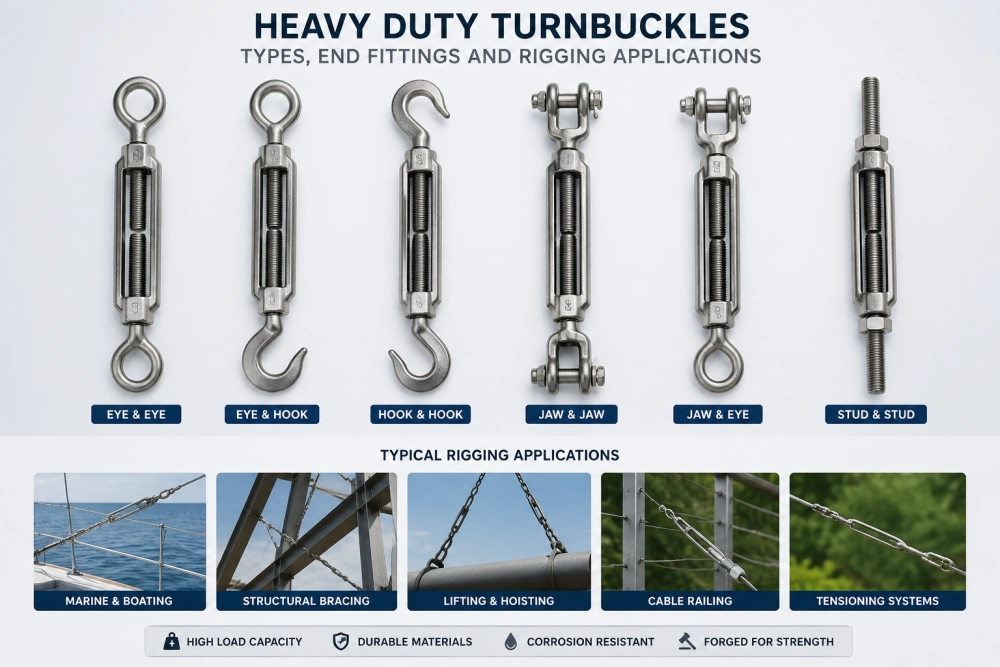
Key differentiators from light-duty models include forged end fittings instead of cast, higher safety factors (5:1 or 6:1 versus 4:1), and material traceability with heat numbers and mill test reports (MTRs). These components are commonly deployed in overhead lifting, structural bracing, marine mooring, and construction tensioning systems where loads are dynamic and consequences of failure are severe.
Material Grades: Forged Steel, Carbon Steel, and Alloy Options
The material specification of a heavy duty turnbuckle directly determines its performance envelope. Three grades dominate the industrial market:
Drop-Forged Carbon Steel (Common for General Rigging)
Most heavy duty turnbuckles in the 1-ton to 12-ton range use drop-forged carbon steel, typically ASTM A29 or AISI 1035/1045 grades. Drop forging aligns the steel’s grain structure along the contour of the fitting, significantly improving fatigue resistance compared to cast alternatives. These turnbuckles often feature a hot-dip galvanized finish for corrosion protection and are used in construction rigging, barge lashing, and temporary structural bracing.
Alloy Steel (High-Strength & Critical Lift Applications)
For applications where weight-to-strength ratio matters — offshore lifting, crane rigging, overhead bridge construction — alloy steel grades such as AISI 4140 or 4340 provide roughly 30% higher WLL than carbon steel equivalents of the same size. Alloy steel turnbuckles typically carry a 5:1 or 6:1 design factor and must meet ASTM A952 or equivalent material standards. They are often quenched and tempered for uniform hardness.
Stainless Steel (Corrosive Environments)
In marine, chemical processing, or food-grade environments, 316 stainless steel heavy duty turnbuckles provide the necessary corrosion resistance without sacrificing mechanical strength. While stainless has a lower yield strength than alloy steel, careful sizing and the use of 17-4 PH or duplex stainless grades can bridge performance gaps. These are common in seafood processing rigging, desalination plant hardware, and offshore platform cable tensioning systems.
End Fitting Types for Heavy Duty Applications
Heavy duty turnbuckles come in several end-fitting configurations, each suited to specific rigging geometries:
- Jaw & Jaw: Two clevis-style ends with pins. Ideal for connecting to pad eyes, lifting lugs, or shackles. Easily removable for inspection.
- Eye & Eye: Two closed forged eyes. Common in cable-stayed structures and permanent installations where disconnection is infrequent.
- Hook & Eye (or Hook & Hook): Quick-connect ends for temporary rigging. Lower WLL than jaw/eye types for the same body size — derating is typically 25–30%.
- Stub & Stub / Threaded Stud Ends: Used in turnbuckle assemblies that weld or thread directly into structural members for architectural tension rods.
- Combination (Jaw & Eye): One jaw end for pinned connection, one eye end for fixed attachment — the most versatile configuration for mixed-mounting scenarios.
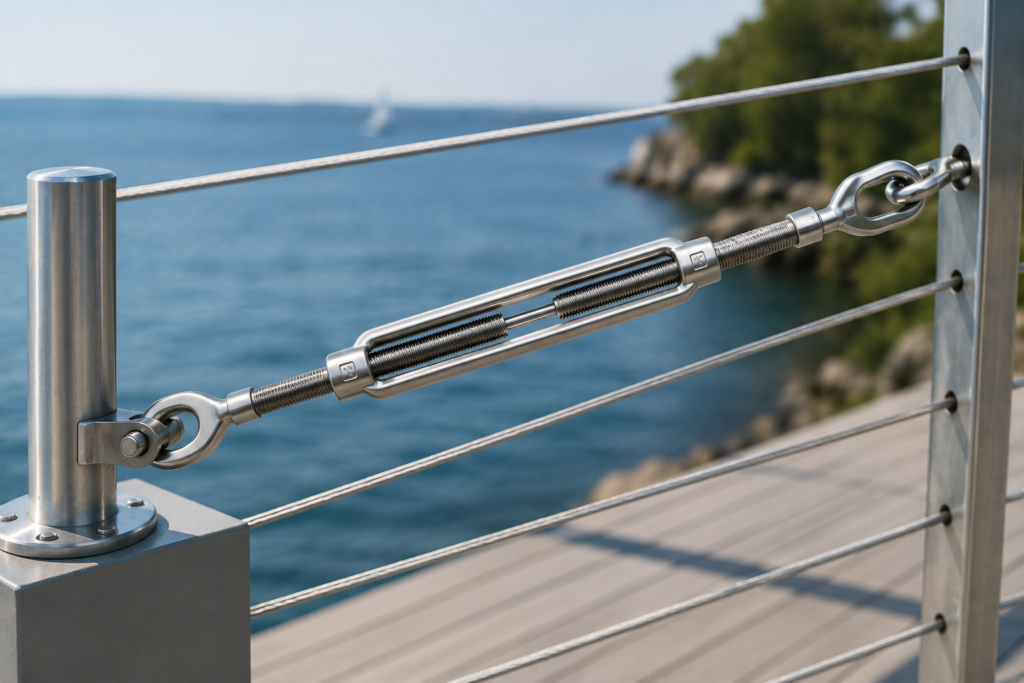
When specifying end fittings, always confirm that the end fitting WLL matches or exceeds the body WLL. A 5-ton body with 3-ton rated hooks creates a system bottleneck that undermines the entire assembly.
Understanding Load Ratings: WLL, Breaking Strength, and Safety Factors
One of the most common procurement mistakes is confusing Working Load Limit (WLL) with Minimum Breaking Strength (MBS). These are fundamentally different values:
| Rating | Definition | Heavy Duty Typical |
|---|---|---|
| WLL | Maximum allowable load in service | 2,200–75,000 lb |
| MBS / Ultimate Load | Load at which failure occurs | WLL × Design Factor |
| Design Factor (Safety Factor) | MBS ÷ WLL | 5:1 (rigging), 4:1 (general), 6:1 (overhead lifting) |
| Proof Load | Test load applied at factory | 2× WLL (typical for forged fittings) |
For example, a heavy duty turnbuckle with a 5:1 design factor rated at 10,000 lb WLL must withstand 50,000 lb before breaking. In overhead lifting applications governed by ASME B30.26, the design factor requirements tighten further, and proof testing with certificates becomes mandatory.
Procurement engineers should always request a Certificate of Conformance (CoC) or mill certification that ties the heat number to mechanical properties. Reputable manufacturers — including those producing to ASTM F1145 (standard specification for turnbuckles) — provide this documentation as standard for heavy duty products.
Common Industrial Applications
Heavy duty turnbuckles appear across nearly every sector that involves structural tensioning or load-bearing rigging:
- Construction & Civil Engineering: Temporary bracing for steel frame erection, bridge cable tensioning, formwork tie-down systems.
- Marine & Offshore: Mooring line tensioners, towing bridle assemblies, container lashing on cargo vessels.
- Mining & Heavy Equipment: Dragline tensioning, conveyor belt take-up assemblies, crusher mounting tie-rods.
- Power Transmission: Guy wire tensioning for transmission towers, substation busbar support systems.
- Entertainment Rigging: Overhead truss tensioning for concert staging and theater fly systems — where a dropped load is catastrophic.
- Architectural Tension Structures: Cable-net facades, tension rod canopies, pedestrian bridge cable stays.
Inspection, Maintenance, and Service Life
Heavy duty turnbuckles in critical service should be inspected at intervals defined by the application standard — typically every 6 to 12 months for permanent installations, and before each use for removable rigging gear. A thorough inspection covers:
- Thread condition — look for galling, corrosion pitting, or deformation on Acme or UNC thread forms
- End fitting wear — pin holes should remain round within 5% tolerance; elongated holes indicate overload
- Body straightness — any visible bend or bow is grounds for immediate removal from service
- Corrosion — surface rust on carbon steel bodies is acceptable if pitting depth is under 0.010″; anything deeper warrants replacement
- Locking mechanism — jam nuts or lock nuts must be present and functional; wire-locked studs must show no sign of loosening
Specifying the Right Heavy Duty Turnbuckle: A Procurement Checklist
When sourcing heavy duty turnbuckles for an industrial project, the following specification sheet will help you communicate requirements clearly to suppliers and avoid costly rework:
- Required WLL — specify in pounds or metric tons, including whether the rating applies to the body only or the full assembly with end fittings.
- End fitting type — jaw/jaw, eye/eye, hook/eye, or combination. Include pin diameter for jaw ends.
- Take-up length — the adjustable range measured from pin center to pin center (closed vs. open length).
- Material grade — carbon steel (ASTM A29), alloy steel (4140/4340), or stainless (304/316).
- Finish — hot-dip galvanized (ASTM A153), zinc-plated, self-colored, or painted.
- Design factor — 4:1, 5:1, or 6:1 based on application standard (ASME B30.26, ASTM F1145, EN 1677).
- Documentation — Certificate of Conformance, mill test report, proof load certificate.
- Marking requirements — WLL, manufacturer ID, heat number, and traceability code stamped on the body.
Working with a fabricator that offers custom metal hardware and in-house forging capabilities allows you to specify non-standard take-up lengths, custom end fitting dimensions, and batch-level certification — options that off-the-shelf catalog products rarely provide.
For procurement teams managing multi-site rigging inventories, standardizing on a single heavy duty turnbuckle specification across projects reduces inspection overhead and simplifies spare-parts management. Contact our engineering team at CraftMetal Works to discuss your specific heavy duty hardware requirements, including custom end fitting machining and batch-level material certification.