What Are Galvanized Turnbuckles?
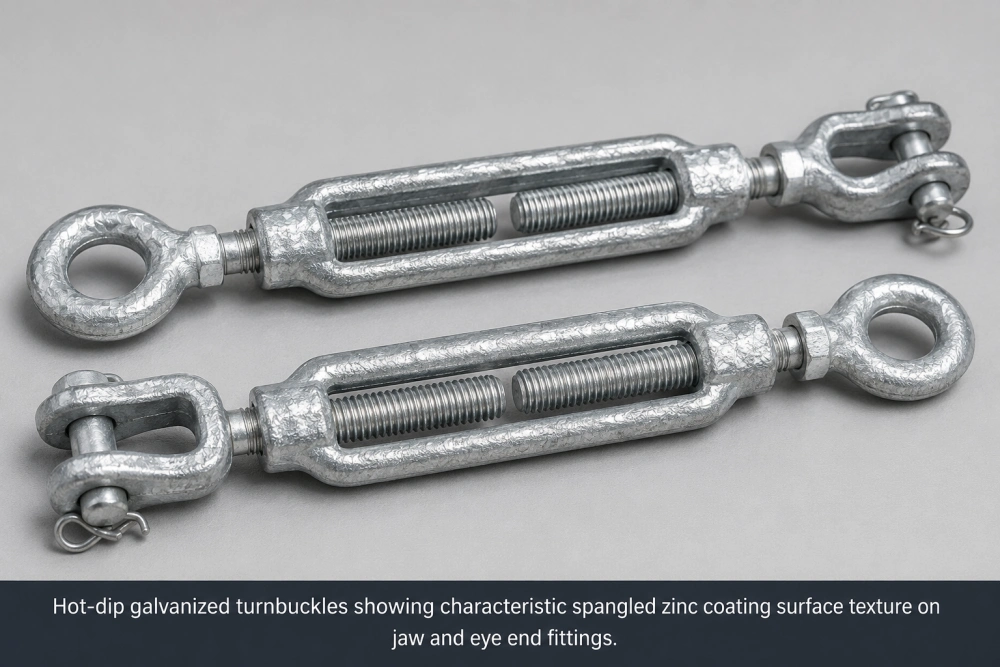
Galvanized turnbuckles are rigging hardware components manufactured from carbon steel and coated with a protective zinc layer through a hot-dip galvanizing process. This zinc coating serves as a sacrificial barrier, protecting the underlying steel from rust and corrosion in outdoor, marine, and high-humidity environments. For B2B buyers sourcing rigging hardware, galvanized turnbuckles offer a cost-effective balance between the strength of forged steel and the corrosion resistance needed for long-term outdoor service.
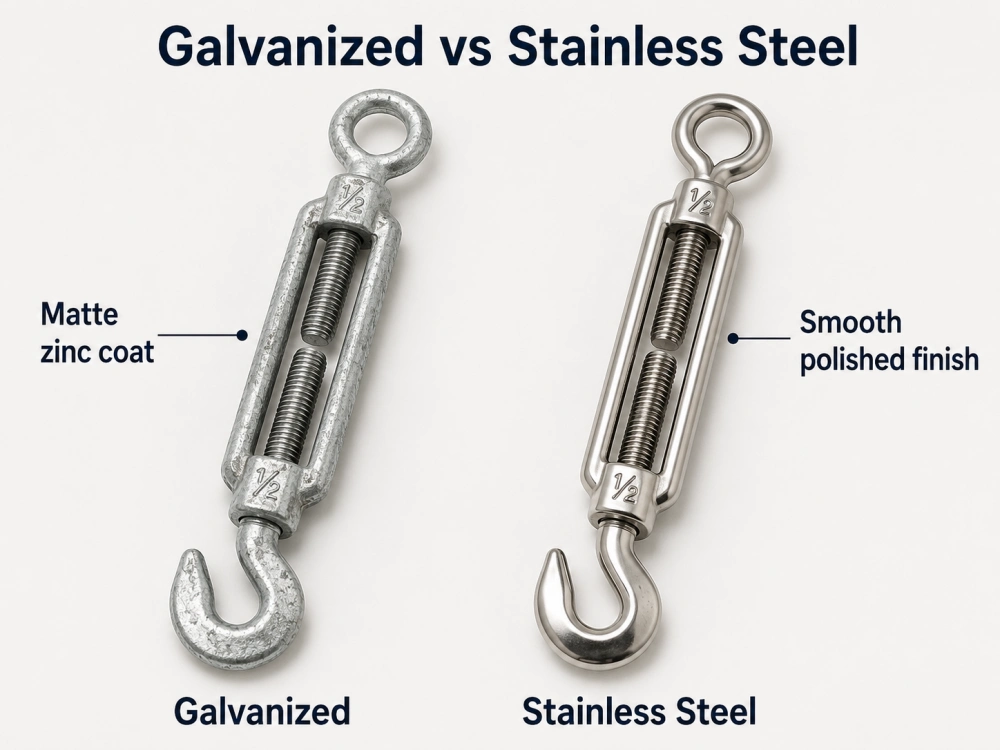
Unlike stainless steel turnbuckles, which rely on alloy chemistry for corrosion resistance, galvanized turnbuckles achieve protection through a physical zinc layer applied after forging. This makes them significantly more affordable than stainless steel equivalents while still delivering reliable performance in most non-marine outdoor applications.
The Hot-Dip Galvanizing Process for Turnbuckles
Understanding the galvanizing process helps buyers evaluate product quality and performance. The hot-dip galvanizing process for turnbuckles involves several critical stages:
- Surface Preparation — The forged steel turnbuckle bodies and end fittings are degreased, acid-pickled, and flux-treated to remove all oxides, oils, and mill scale. Clean steel is essential for proper zinc adhesion.
- Molten Zinc Bath — Components are immersed in a bath of molten zinc at approximately 450°C (840°F). The zinc reacts with the steel surface to form a series of zinc-iron alloy layers.
- Withdrawal and Draining — Parts are slowly withdrawn from the bath at a controlled rate to allow excess zinc to drain off, ensuring a uniform coating without drips or runs that could interfere with thread function.
- Cooling and Inspection — The galvanized turnbuckles are cooled in air or water quench tanks, then inspected for coating thickness, surface uniformity, and thread integrity.
The resulting coating typically ranges from 45 to 85 microns (1.8 to 3.4 mils) in thickness, depending on the steel chemistry, immersion time, and withdrawal speed. This coating provides both barrier protection (physically isolating steel from the environment) and galvanic protection (zinc sacrifices itself preferentially to protect exposed steel at scratches or edges).
Galvanized vs. Stainless Steel Turnbuckles: Cost-Benefit Analysis
One of the most common sourcing decisions is choosing between galvanized and stainless steel turnbuckles. The right choice depends on the application environment, budget, and required service life:
| Factor | Galvanized Turnbuckles | Stainless Steel Turnbuckles |
|---|---|---|
| Base Material | Forged carbon steel + zinc coating | AISI 304 or 316 alloy steel |
| Tensile Strength | Comparable (depends on steel grade) | Comparable (depends on alloy) |
| Corrosion Resistance | Good — 10-20 years in mild outdoor conditions | Excellent — 30+ years, even in coastal/marine |
| Cost (Relative) | 1x (baseline) | 2.5x to 4x more expensive |
| Best Environment | Inland construction, industrial, fencing | Marine, coastal, chemical, food processing |
| Coating Damage Risk | Zinc can chip or wear at threads | No coating to damage |
| Thread Galling | Low risk | Higher risk (especially 304) |
Types of Galvanized Turnbuckles Available
Galvanized turnbuckles are available in the same end fitting configurations as other turnbuckle types, ensuring compatibility with existing rigging systems:
- Jaw & Jaw Galvanized Turnbuckles — Clevis pin connections on both ends. Ideal for wire rope assemblies, guardrail systems, and structural tie-rods. Easy to install and remove for maintenance.
- Eye & Eye Galvanized Turnbuckles — Closed loop eyes on both ends. Used in permanent or semi-permanent installations such as cable bracing, fence tensioning, and architectural guy wires.
- Hook & Eye Galvanized Turnbuckles — One quick-connect hook and one eye. Suitable for applications requiring frequent adjustment, such as temporary barrier cables and tent guy lines.
- Stub End Galvanized Turnbuckles — Threaded stub ends for welding or threading into fabricated assemblies. Common in OEM equipment and custom structural applications.
Key Specifications to Verify When Sourcing
Zinc Coating Thickness
Request a minimum coating thickness specification from your supplier. For general outdoor use, ASTM A153 Class C specifies a minimum of 1.0 oz/ft² (43 microns) for forged hardware. For more aggressive environments, look for coatings of 2.0 oz/ft² (86 microns) or higher. Coating thickness can be verified non-destructively using a magnetic thickness gauge.
Thread Standards and Compatibility
Galvanized turnbuckles are available in both metric (M6 through M48) and imperial (1/4″ through 2″) thread sizes. After galvanizing, threads must be re-cut or chased to remove excess zinc and ensure smooth operation. Verify that the supplier performs post-galvanizing thread cleaning to prevent galling and ensure proper jam nut function.
Working Load Limit (WLL) Certification
Galvanized turnbuckles should comply with ASTM F1145 for forged turnbuckles. Request WLL documentation that specifies the safety factor used (typically 4:1 or 5:1). The galvanizing process does not significantly reduce the load-bearing capacity of properly forged steel, but always confirm that load ratings are post-galvanizing, not pre-galvanizing values.
Common Industrial Applications
- Utility and Power Line Guying — Galvanized turnbuckles tension guy wires on utility poles and transmission towers. The zinc coating provides decades of maintenance-free service in inland environments.
- Construction Bracing — Temporary and permanent structural bracing uses galvanized turnbuckles for adjustable tie-rod assemblies in steel-frame buildings.
- Fencing and Agriculture — High-tensile wire fencing relies on galvanized eye & eye turnbuckles to maintain consistent tension across long runs, compensating for thermal expansion and ground movement.
- Marine Dock and Harbor Hardware — In sheltered harbor areas (not full offshore), galvanized turnbuckles provide adequate corrosion resistance at a fraction of stainless steel cost.
- Industrial Equipment Tensioning — Conveyor systems, material handling equipment, and processing machinery use galvanized turnbuckles for belt and chain tension adjustment.
Maintenance and Service Life
While galvanized turnbuckles require minimal maintenance, the following practices extend service life:
- Periodic Inspection — Check annually for zinc coating wear, especially at thread engagement points where friction is highest. Gray or rust-colored spots indicate zinc depletion.
- Thread Lubrication — Apply a light coating of zinc-rich grease to threads to reduce friction wear on the zinc layer and prevent galling.
- Avoid Mixing Metals — Connecting galvanized turnbuckles directly to stainless steel components can accelerate zinc loss through galvanic corrosion. Use insulating washers or isolation fittings when necessary.
- Coating Repair — Small areas of zinc damage can be repaired using zinc-rich paint or cold galvanizing compound containing at least 90% metallic zinc by weight.
Why Source Galvanized Turnbuckles from CraftMetal Works
At CraftMetal Works, we manufacture galvanized turnbuckles from forged carbon steel with hot-dip galvanizing per ASTM A153 standards. Our products are available in jaw & jaw, eye & eye, hook & eye, and stub end configurations, with thread sizes from M6 to M48 (1/4″ to 2″). Each batch includes material certificates, coating thickness reports, and WLL documentation.
We also offer custom fabrication for special thread pitches, extended take-up lengths, and non-standard end fittings. Contact our team to discuss your galvanized turnbuckle requirements or request a quote.
Frequently Asked Questions
Can galvanized turnbuckles be used in saltwater environments?
Galvanized turnbuckles can be used in sheltered harbor and dock applications with limited salt spray exposure. For continuous saltwater immersion or offshore platforms, stainless steel 316 turnbuckles are strongly recommended as the zinc coating will degrade rapidly in direct saltwater contact.
Does galvanizing affect the strength of the turnbuckle?
Properly executed hot-dip galvanizing does not significantly affect the mechanical properties of forged steel turnbuckles. The process temperature (450°C) is below the tempering temperature of standard carbon steel grades used for rigging hardware. Always confirm that load ratings are certified post-galvanizing.
How long does the zinc coating last on galvanized turnbuckles?
In typical inland outdoor environments, a 50-micron zinc coating provides 15-25 years of corrosion protection before significant steel exposure occurs. In urban or industrial areas with higher pollution, service life may be 10-15 years. In coastal areas with salt spray, expect 5-10 years depending on proximity to the shoreline.
What is the difference between hot-dip galvanized and electro-galvanized turnbuckles?
Hot-dip galvanizing produces a thicker coating (45-85+ microns) with zinc-iron alloy layers bonded to the steel. Electro-galvanizing produces a thinner, pure zinc coating (5-15 microns) without alloy layers. For outdoor rigging applications, hot-dip galvanizing is strongly preferred due to its superior durability and longer service life.