Introduction
Small turnbuckles are indispensable components in countless light-duty tensioning applications across marine, architectural, automotive, and industrial sectors. Despite their compact size, these precision-engineered hardware fittings deliver reliable load management for cable railing systems, light rigging assemblies, awning installations, and equipment tie-downs. For procurement managers and engineers sourcing compact tensioning solutions, understanding the material grades, end-fitting configurations, and load specifications of small turnbuckles is essential to making informed purchasing decisions.
At CraftMetal Works, we supply a comprehensive range of small turnbuckles manufactured from stainless steel, galvanized carbon steel, and brass — each tailored to specific environmental and load requirements. This guide examines the key specifications, material choices, and application scenarios that define small turnbuckle selection in industrial procurement.
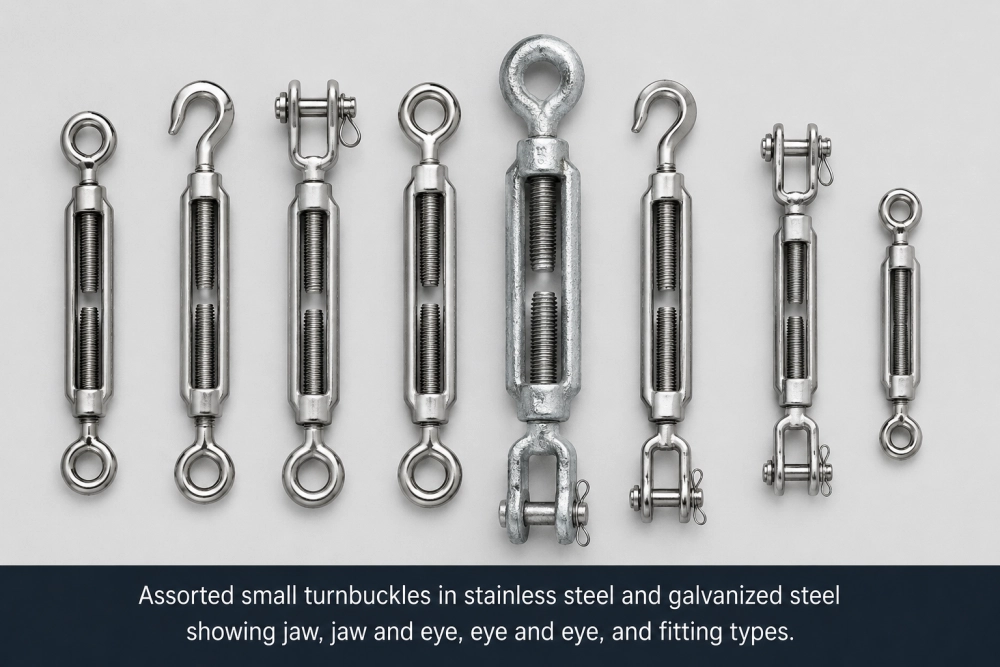
What Defines a Small Turnbuckle?
The term “small turnbuckle” typically refers to units with a body length under 6 inches (152 mm) and thread diameters ranging from M5 (5 mm) to M12 (12 mm) or 1/4-inch to 1/2-inch in imperial sizing. These compact tensioners are designed for light to moderate loads — generally between 100 lb (45 kg) and 2,200 lb (1,000 kg) working load limit (WLL), depending on material and thread grade.
Small turnbuckles share the same fundamental design as their heavy-duty counterparts: a central body with reverse-threaded ends that rotate to increase or decrease tension along a connected assembly. The distinction lies in their material thickness, thread pitch, and end-fitting geometry — all optimized for space-constrained installations where a full-size turnbuckle would be impractical.
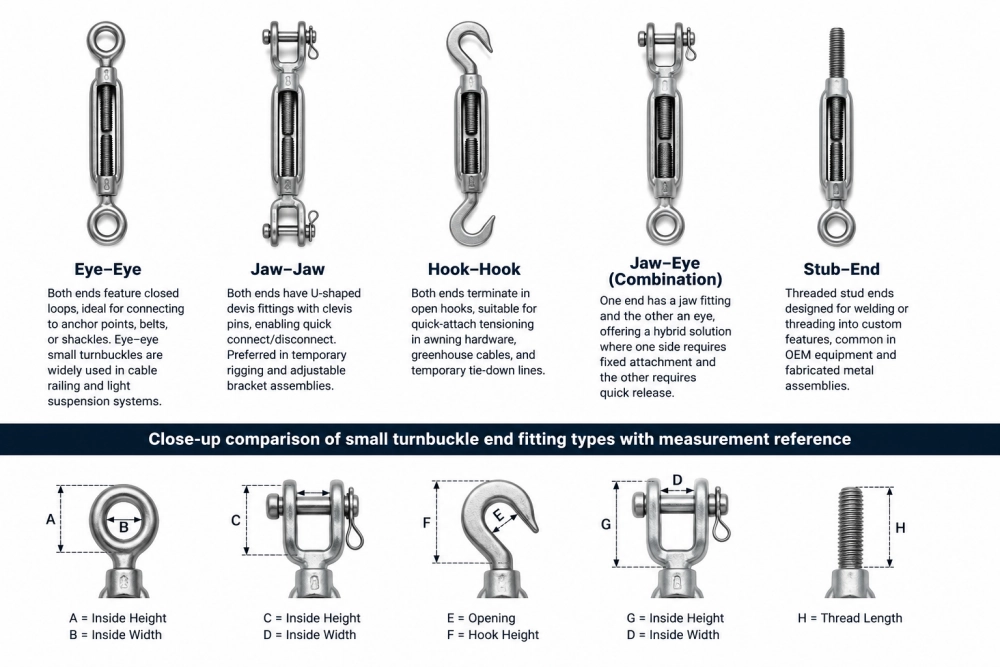
Common End Fitting Types
- Eye-Eye: Both ends feature closed loops, ideal for connecting to anchor points, bolts, or shackles. Eye-eye small turnbuckles are widely used in cable railing and light suspension systems.
- Jaw-Jaw: Both ends have U-shaped clevis fittings with clevis pins, enabling quick connect/disconnect. Preferred in temporary rigging and adjustable bracket assemblies.
- Hook-Hook: Both ends terminate in open hooks, suitable for quick-attach tensioning in awning hardware, greenhouse cables, and temporary tie-down lines.
- Jaw-Eye (Combination): One end has a jaw fitting and the other an eye, offering a hybrid solution where one side requires fixed attachment and the other requires quick release.
- Stub-End: Threaded stud ends designed for welding or threading into custom fixtures, common in OEM equipment and fabricated metal assemblies.
Material Selection Guide
Material choice directly affects a small turnbuckle’s corrosion resistance, load capacity, and service life. The table below compares the three most common materials used in small turnbuckle manufacturing.
| Material | Grade / Alloy | Typical WLL Range | Corrosion Resistance | Best Applications |
|---|---|---|---|---|
| Stainless Steel | AISI 304 / 316 | 100–1,500 lb (45–680 kg) | Excellent (316 for marine) | Marine rigging, cable railing, outdoor architectural, food-grade equipment |
| Galvanized Carbon Steel | Grade 2 / Grade 5 | 150–2,200 lb (68–1,000 kg) | Good (zinc coating) | General industrial, construction bracing, agricultural fencing, temporary structures |
| Brass | C360 / C464 | 80–800 lb (36–360 kg) | Good (natural patina) | Decorative architectural, electrical grounding, marine (non-structural), musical instrument stands |
Stainless Steel Grades: 304 vs. 316
For small turnbuckles destined for coastal or chemically aggressive environments, AISI 316 stainless steel is the preferred choice. The addition of 2–3% molybdenum in 316-grade steel significantly enhances resistance to chloride-induced pitting corrosion. AISI 304 stainless steel, while more economical, performs adequately in freshwater, indoor, and general atmospheric conditions. Buyers should request mill test certificates (MTCs) to verify material grade compliance, particularly for projects governed by ASTM A193 or ISO 3506 standards.
Load Ratings and Safety Factors
Small turnbuckle load ratings must be interpreted with the design safety factor in mind. In North American rigging practice, a 5:1 safety factor is standard — meaning a turnbuckle marked with a 500 lb (227 kg) WLL has a minimum breaking strength (MBS) of 2,500 lb (1,134 kg). European standards (EN 12195, EN 818) often apply different safety factors depending on the application category.
Procurement teams should verify that the supplier provides:
- Documented WLL stamped or laser-etched on the turnbuckle body
- Third-party load test certificates for batch traceability
- Conformity declarations for regulated applications (e.g., CE marking for EU markets)
- Material certificates identifying heat numbers and chemical composition
Key Industries and Use Cases
Cable Railing and Architectural Tension Systems
Small stainless steel turnbuckles are the standard solution for tensioning stainless cable in residential and commercial railing installations. Eye-eye turnbuckles in 316 stainless connect cable ends to posts and intermediate supports, providing both initial tensioning and periodic re-tensioning capability as cables settle over time. A typical 1/8-inch (3 mm) cable railing system uses M6 or 1/4-inch small turnbuckles rated at 1,200–1,800 lb WLL per unit.
Marine and Boat Rigging
In marine applications, small turnbuckles tension lifelines, backstays, and bimini top straps. 316 stainless is mandatory for saltwater exposure, and many marine specifications require electropolished finishes to eliminate surface imperfections where corrosion could initiate. Jaw-jaw turnbuckles are preferred for lifelines due to their secure clevis pin attachment that prevents accidental disconnection under dynamic loading.
Agricultural and Greenhouse Construction
Galvanized small turnbuckles are extensively used in greenhouse cable bracing, vineyard trellis systems, and livestock fencing tensioners. The hot-dip galvanized coating provides cost-effective corrosion protection for outdoor agricultural environments, and hook-end configurations enable rapid installation and seasonal adjustments.
Purchasing Considerations for Bulk Buyers
When sourcing small turnbuckles in volume, procurement professionals should evaluate the following criteria beyond unit price:
- Thread quality: Rolled threads provide superior fatigue resistance compared to cut threads. Verify thread form compliance to ANSI/ASME B1.1 (UNC/UNF) or ISO metric standards.
- Surface finish: Specify passivation for stainless steel (per ASTM A967) and hot-dip galvanizing thickness (minimum 45 microns per ASTM A153) for carbon steel turnbuckles.
- Batch consistency: Request pre-production samples and establish acceptance criteria for dimensional tolerances, particularly for OEM integration where consistent body length is critical.
- Packaging and labeling: Bulk packaging should prevent thread damage during transit. Individual labeling with WLL, material grade, and lot number supports inventory traceability.
- MOQ flexibility: Verify minimum order quantities and lead times for custom end-fitting combinations. Many manufacturers offer mixed-size pallets for distributors.
Frequently Asked Questions
What is the smallest turnbuckle size commercially available?
Standard off-the-shelf small turnbuckles start at M5 (5 mm) thread diameter with body lengths around 3–4 inches (76–102 mm). Custom micro turnbuckles with M3 or M4 threads are available through specialty manufacturers for precision instrument and medical device applications, though these are typically made to order.
Can small turnbuckles be used for overhead lifting?
No. Small turnbuckles are designed for tensioning and static load management, not for overhead lifting. Lifting applications require dedicated rigging hardware rated to ASME B30.26 or equivalent lifting standards. Using a small turnbuckle for overhead lifting bypasses critical safety design features and violates occupational safety regulations in most jurisdictions.
How do I prevent small turnbuckles from loosening under vibration?
Several methods prevent vibration-induced loosening: (1) use lock nuts or jam nuts tightened against the turnbuckle body after tensioning is set, (2) apply thread-locking compound (medium-strength anaerobic adhesive) to the threads, (3) secure the turnbuckle body with safety wire through a pre-drilled hole, or (4) specify turnbuckles with integrated locking collars. For high-vibration environments such as engine compartments or heavy machinery, a combination of mechanical locking and thread adhesive is recommended.
What is the difference between hot-dip galvanized and electro-galvanized small turnbuckles?
Hot-dip galvanizing immerses the turnbuckle in molten zinc, producing a thick (45–85 micron) metallurgically bonded coating suitable for outdoor and industrial exposure. Electro-galvanizing (zinc electroplating) deposits a thinner (5–25 micron) decorative and mildly protective layer best suited for indoor or low-corrosion environments. For cost-sensitive outdoor applications, hot-dip galvanized small turnbuckles offer the best value-to-durability ratio.
Conclusion
Small turnbuckles deliver essential tensioning functionality across a diverse range of light-duty industrial, marine, and architectural applications. Selecting the right material grade, end-fitting type, and load rating ensures reliable long-term performance and regulatory compliance for your project or product line.
CraftMetal Works supplies small turnbuckles in stainless steel (304/316), galvanized carbon steel, and brass with custom end-fitting configurations available for volume orders. Our in-house quality inspection and batch traceability systems support ISO-compliant procurement requirements for OEM manufacturers, construction contractors, and hardware distributors worldwide.
To discuss your small turnbuckle specifications, request a quote, or receive material samples for evaluation, please contact our sales team or browse our industrial metal hardware catalog for standard product dimensions and pricing.