What Is an Eye to Eye Turnbuckle?
An eye to eye turnbuckle is a rigging hardware component featuring eye-shaped end fittings on both ends of an adjustable threaded body. Each eye fitting forms a closed loop that accommodates shackles, wire rope thimbles, or other attachment hardware, enabling secure connections in tension-adjustment applications. Unlike jaw or hook end types, the closed-eye design prevents accidental disengagement under dynamic loads, making eye to eye turnbuckles a preferred choice for permanent or semi-permanent installations in marine, construction, and industrial rigging systems.
At CraftMetal Works, we manufacture eye to eye turnbuckles in carbon steel, stainless steel, and galvanized variants, with working load limits ranging from 500 lb to over 20,000 lb. This guide covers the types, sizing criteria, material grades, and application considerations that sourcing managers and engineers need when specifying eye to eye turnbuckles for wire rope assemblies.
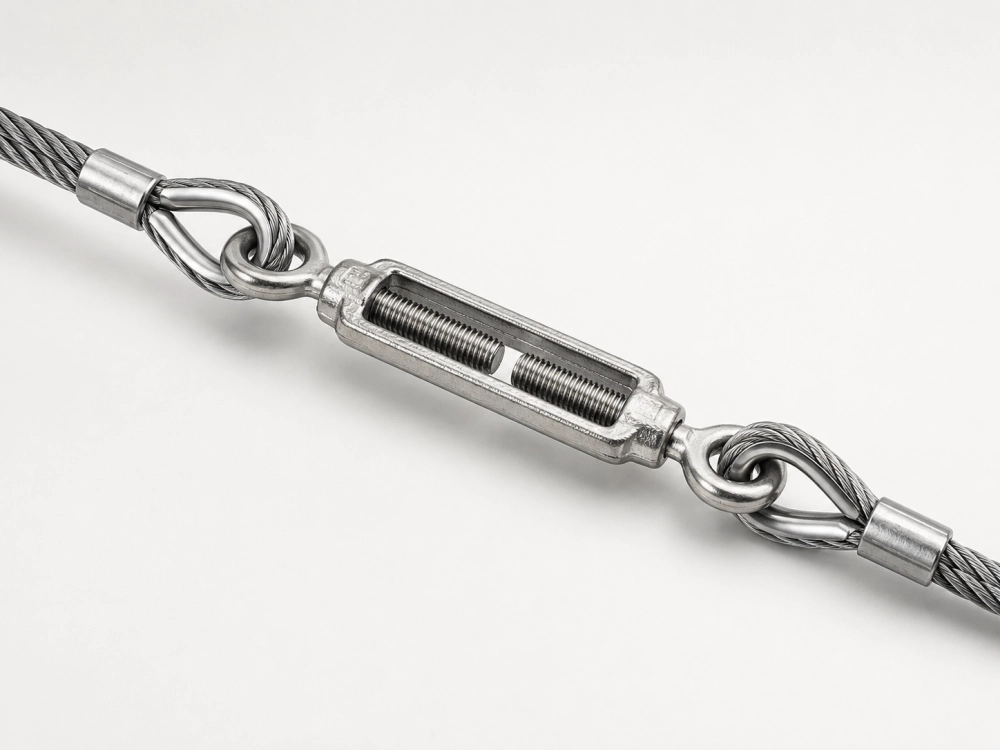
Eye to Eye Turnbuckle Types and Configurations
Open-Body vs. Closed-Body Designs
Eye to eye turnbuckles come in two primary body configurations:
- Open-body (stub) turnbuckles — The threaded central tube is exposed, allowing visual confirmation of thread engagement. These are the most common type for general rigging and are available in the widest range of sizes.
- Closed-body (pipe) turnbuckles — The threaded mechanism is enclosed within a tubular housing, protecting threads from dirt, corrosion, and accidental adjustment. Closed-body turnbuckles are specified for marine environments and outdoor installations where thread protection is critical.
Take-Up Length and Thread Direction
Take-up length refers to the maximum adjustment range a turnbuckle provides when fully extended or collapsed. The right-hand/left-hand (RH/LH) thread pairing — one end threaded right-hand, the other left-hand — ensures that rotating the body tightens or loosens both ends simultaneously without twisting the attached wire ropes. This is the standard thread configuration for all eye to eye turnbuckles used in rigging.
Forged vs. Cast Eye Fittings
Eye end fittings are manufactured either by forging or casting:
- Forged eyes — Produced by hot-working carbon or stainless steel under press pressure. Forged eyes offer superior grain structure continuity, higher ductility, and better fatigue resistance. All US Federal Specification FF-T-791 and MIL-Spec turnbuckles use forged fittings.
- Cast eyes — Investment-cast from stainless steel alloys. Cast turnbuckles are cost-effective for smaller sizes and lighter-duty applications but have lower impact resistance compared to forged equivalents.
Material Grades and Corrosion Resistance
Selecting the right material grade is essential for matching the turnbuckle to its operating environment:
| Material | Grade / Spec | WLL Range | Corrosion Resistance | Best Applications |
|---|---|---|---|---|
| Carbon Steel (Forged) | FF-T-791 Type I | 1,200 – 20,000 lb | Low (requires galvanizing) | General rigging, construction, formwork |
| Hot-Dip Galvanized | FF-T-791 Type I, galvanized | 1,200 – 20,000 lb | Medium (zinc coating protection) | Outdoor structures, fencing, marine docks |
| Type 304 Stainless | AISI 304, cast or forged | 500 – 10,000 lb | High (chromium oxide passive layer) | Marine rigging, architectural cables, food processing |
| Type 316 Stainless | AISI 316, forged | 500 – 10,000 lb | Very high (molybdenum addition for saltwater) | Saltwater marine, offshore platforms, chemical plants |
Type 316 stainless steel eye to eye turnbuckles are the standard specification for saltwater marine applications. The 2–3% molybdenum content significantly improves resistance to pitting corrosion in chloride-rich environments, extending service life by 3–5× compared to Type 304 in seawater service.
Load Ratings and Sizing Selection
Working Load Limit (WLL) vs. Minimum Breaking Strength (MBS)
Every eye to eye turnbuckle is rated with a Working Load Limit (WLL) — the maximum load that may be applied in normal service — and a Minimum Breaking Strength (MBS), typically 4–6× the WLL. The design factor (4:1 for general rigging per ASME B30.26, 5:1 or 6:1 for critical lifts) determines the margin between WLL and MBS. Never exceed the WLL rating marked on the turnbuckle body.
Matching Turnbuckle Size to Wire Rope Diameter
The turnbuckle eye fitting must accommodate the wire rope thimble or shackle that attaches to the rope. A common sizing rule: the eye inside diameter should be at least 1.5× the wire rope diameter to allow proper thimble seating. For example, a 1/2″ wire rope typically pairs with a 3/4″ or larger eye ID turnbuckle. Using undersized turnbuckles leads to poor thimble fit, uneven load distribution, and premature wear at the eye-thimble interface.
Key sizing parameters for standard eye to eye turnbuckles:
- Body diameter — Determines thread engagement area and overall WLL capacity
- Eye inside diameter — Must accommodate shackle pin or thimble width
- Take-up length — Maximum adjustment range for tensioning the assembly
- Overall length (extended) — Must fit within the available space in the rigging layout
Industrial Applications for Eye to Eye Turnbuckles
Wire Rope Tensioning Systems
Eye to eye turnbuckles are the standard tensioning component in wire rope guying systems, cable barriers, and structural bracing. The closed-eye fitting securely holds wire rope thimbles, preventing the rope from slipping out under cyclic loading. In tensioned cable facade systems for modern architecture, Type 316 stainless eye to eye turnbuckles provide both structural adjustment capability and long-term corrosion resistance in exposed conditions.
Marine Rigging and Dock Hardware
In marine applications, eye to eye turnbuckles adjust mooring line tension, stay wire length on sailboats, and dock fender system positioning. The closed-eye fitting is preferred over jaw or hook types because it cannot accidentally release if the vessel shifts under wave action. For saltwater service, Type 316 stainless or hot-dip galvanized (with supplementary epoxy coating) turnbuckles are specified.
Construction Formwork and Shoring
Concrete formwork systems use eye to eye turnbuckles to adjust and lock tie-rod tension, ensuring form alignment under hydrostatic concrete pressure. The eye fitting directly attaches to form hardware shackles or wedge anchors, providing a closed-loop connection that resists vibration-induced loosening during concrete placement operations.
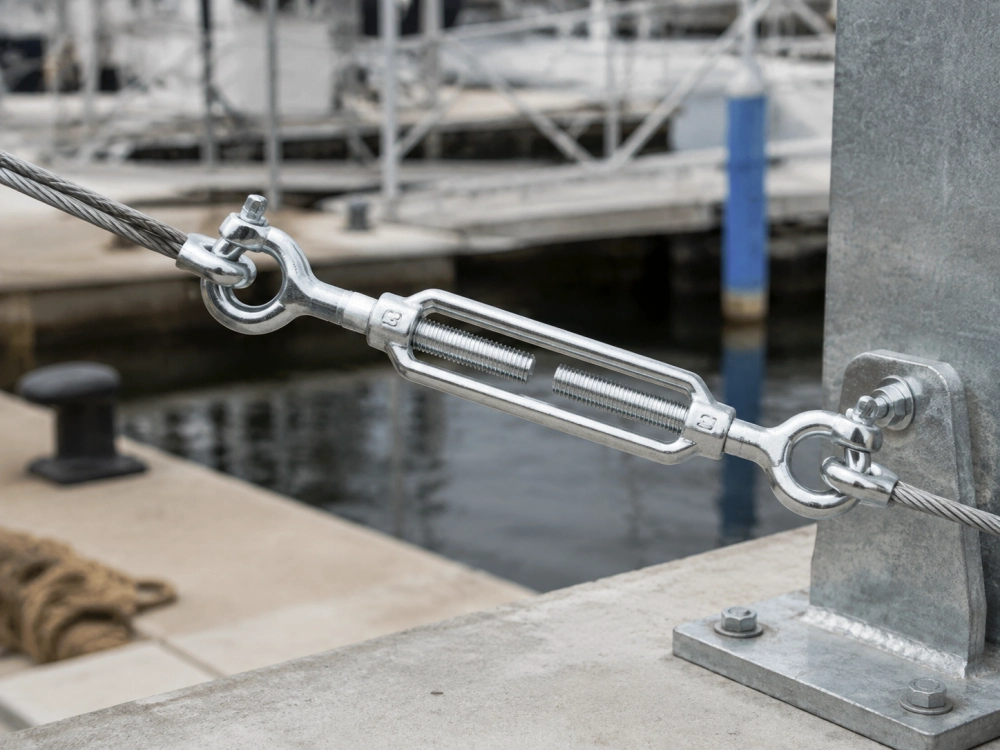
Installation and Safety Best Practices
- Thread engagement check — At least 6 full threads must be engaged on each end at final tension. Open-body turnbuckles allow visual verification; closed-body types require measurement of the exposed thread length.
- Locking devices — Install lock nuts, cotter pins, or wire wraps through the body-end fitting holes after final adjustment to prevent accidental rotation. This is mandatory per ASME B30.26 for all rigging applications.
- Lubrication — Apply anti-seize compound to threads before installation, especially for galvanized or stainless turnbuckles, to prevent galling and ensure smooth adjustment.
- Inspection intervals — Inspect for thread wear, eye deformation, corrosion pitting, and crack indications at regular intervals. Replace any turnbuckle showing visible deformation, cracking, or thread damage.
- No shock loading — Eye to eye turnbuckles are designed for static or gradually applied loads. Shock loads (sudden force spikes) can exceed the MBS even when the static load is within WLL.
Eye to Eye vs. Other Turnbuckle End-Fitting Types
Understanding the trade-offs between end-fitting types helps specify the right turnbuckle for each application:
| End-Fitting Type | Connection Method | Security Level | Typical Use |
|---|---|---|---|
| Eye to Eye | Closed loop → shackle/thimble | High — cannot release accidentally | Permanent/semi-permanent rigging, marine, guy wires |
| Jaw to Jaw | Open jaw → clevis pin/bolt | Medium — pin can be removed | Structural tie rods, equipment leveling |
| Hook to Hook | Open hook → eye bolt/ring | Low — hook can slip off under slack | Temporary tensioning, light-duty applications |
| Hook and Eye | Mixed hook + eye | Medium — eye end secure, hook end can release | Quick-install tensioning, fencing |
For applications where safety and permanent attachment are priorities, eye to eye turnbuckles are the recommended specification. The closed-loop design eliminates the risk of accidental disconnection that exists with hook or jaw end fittings.
Frequently Asked Questions
Can I use an eye to eye turnbuckle for lifting applications?
No. Turnbuckles are designed for tensioning and static load-holding applications, not for overhead lifting. ASME B30.26 classifies turnbuckles as rigging hardware (not below-the-hook lifting devices). For overhead lifts, use rated shackles, eyebolts, or swivel hoist rings instead.
How do I determine the correct eye to eye turnbuckle size for my wire rope?
Match the turnbuckle WLL to your maximum working tension, then verify that the eye inside diameter accommodates the wire rope thimble or shackle. The eye ID should be at least 1.5× the wire rope nominal diameter. Refer to manufacturer sizing charts that cross-reference wire rope diameter, thimble size, and turnbuckle body diameter.
What is the difference between Type 304 and Type 316 stainless eye to eye turnbuckles?
Type 316 contains 2–3% molybdenum, providing significantly better resistance to pitting and crevice corrosion in chloride-rich (saltwater) environments. Type 304 is adequate for freshwater, atmospheric exposure, and indoor/food-processing applications but will pit in continuous saltwater immersion. For marine rigging, always specify Type 316.
Are forged eye turnbuckles stronger than cast ones?
Yes. Forged eyes have continuous grain flow from the eye through the threaded shank, resulting in higher ductility, better fatigue resistance, and superior impact strength. Cast eyes are acceptable for lighter-duty, smaller-size turnbuckles but should not be used in heavy-duty rigging or dynamic-load applications. US Federal Spec FF-T-791 requires forged construction for all rated rigging turnbuckles.
Source Custom Eye to Eye Turnbuckles from CraftMetal Works
Whether you need forged carbon steel turnbuckles for construction rigging, Type 316 stainless eye to eye turnbuckles for marine installations, or hot-dip galvanized units for outdoor structural systems, CraftMetal Works delivers custom-manufactured turnbuckles with verified WLL ratings, certified material traceability, and surface finishes matched to your operating environment.
For custom sizing, non-standard eye diameters, or bulk sourcing inquiries, contact our engineering team to discuss your project specifications. We provide full documentation including mill test reports, dimensional inspection data, and load-test certificates for every order.