What Is a Concrete Turnbuckle?
A concrete turnbuckle is a mechanical tensioning device used primarily in concrete formwork systems to adjust, align, and secure form panels during the pour and curing process. Unlike general-purpose rigging turnbuckles, concrete turnbuckles are engineered to handle the lateral pressure of wet concrete and maintain precise dimensional control throughout the construction sequence.
These turnbuckles connect wall forms to stakes, tie opposing form panels together, or brace single-sided forms against external supports. They allow construction crews to fine-tune alignment to within millimeter tolerances—critical for plumb walls, square corners, and level slabs in commercial, industrial, and infrastructure projects.
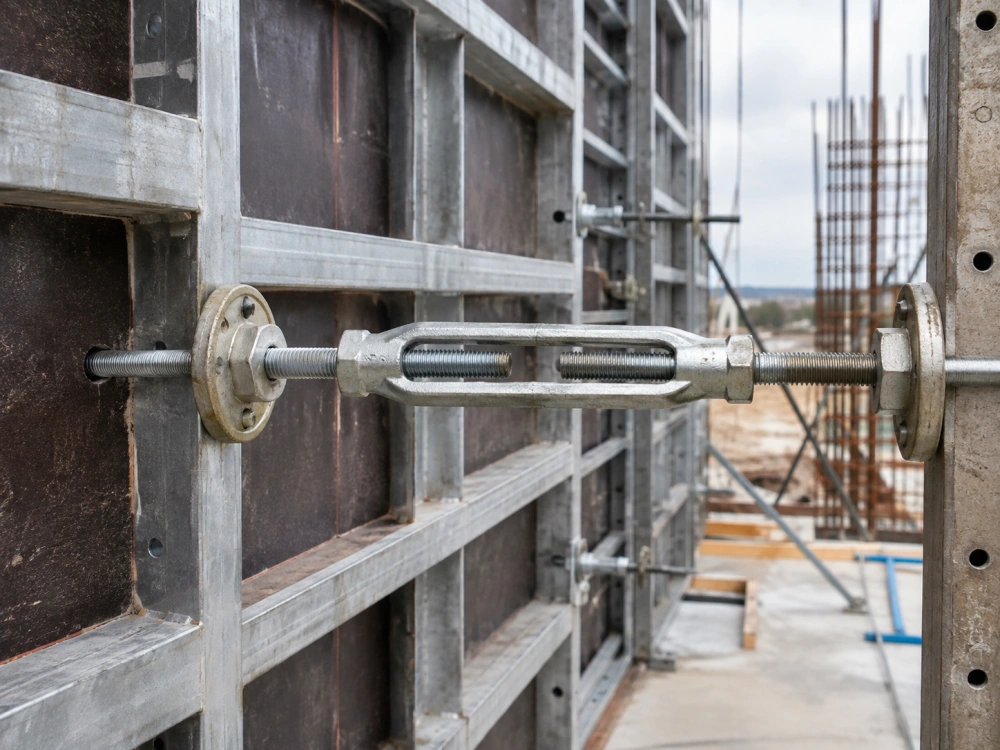
Types of Concrete Turnbuckles by Formwork System
Concrete turnbuckles vary by the formwork method they support. Selecting the correct type depends on form panel weight, pour height, and whether the application requires single-sided or double-sided bracing.
1. Wall Form Turnbuckles (Tie-Rod Type)
These are the most common type, used in double-sided wall forms. A threaded rod runs through both form panels, anchored by wing nuts or hex nuts on each end. The turnbuckle section—typically positioned mid-span—allows crews to pull the panels together or spread them apart. Standard body diameters range from M12 to M24 (1/2″ to 1″), with working load limits from 1.5 to 8.5 metric tons.
2. Single-Sided Form Bracing Turnbuckles
When access is limited to one side—such as retaining walls, basement walls against existing structures, or tunnel linings—single-sided bracing turnbuckles connect the form panel to ground anchors or deadman stakes. These typically feature a longer body stroke (300 mm to 600 mm) for coarse adjustment, with a fine-thread screw mechanism for final alignment.
3. Column Form Alignment Turnbuckles
Used to plumb and brace column forms before the pour. These turnbuckles connect the form to four corner stakes or adjacent structural elements, allowing independent adjustment along both axes. They are typically lighter-duty units with eye or jaw end fittings for quick attachment and release.
4. Slab Edge Form Turnbuckles
For elevated slab edge forms, compact turnbuckles with hook ends secure the edge form to the slab deck below. These are designed for rapid installation and removal, with load ratings calibrated to the hydrostatic pressure profile at the slab perimeter rather than full-wall loads.
Material and Finish Comparison
The material choice for a concrete turnbuckle directly affects its service life, corrosion resistance, and cost profile. Below is a comparison of the three most common material options in the formwork market.
| Material | Corrosion Resistance | Load Capacity (M20) | Typical Service Life | Cost Index | Best For |
|---|---|---|---|---|---|
| Carbon Steel (Black) | Low — rusts quickly | 5.0 tons | 6–12 months outdoor | $ | Single-project use; dry environments |
| Hot-Dip Galvanized | Good — ISO 1461 coating | 5.0 tons | 3–5 years | $$ | Multi-project reuse; general construction |
| Stainless Steel (304/316) | Excellent — marine-grade | 4.2 tons | 15+ years | $$$$ | Marine/infrastructure; permanent installations |
| Electro-Galvanized | Moderate — thin zinc layer | 5.0 tons | 1–2 years | $–$$ | Light formwork; indoor precast |
For most commercial formwork operations, hot-dip galvanized concrete turnbuckles offer the best balance of durability and cost. The thicker zinc coating resists concrete splatter and jobsite moisture, extending usable life across multiple projects. Our industrial metal hardware range includes both galvanized and stainless steel options for formwork applications.
Key Specifications to Consider When Sourcing
Engineers and procurement managers should evaluate the following parameters when specifying concrete turnbuckles for a construction project.
- Working Load Limit (WLL): Must exceed calculated form pressure by a safety factor of at least 4:1. For a wall form experiencing 50 kN/m² of concrete pressure, the turnbuckle spacing and WLL must be verified jointly.
- Body Stroke Length: Determines the adjustment range. Long-stroke units (400 mm+) reduce the need for intermediate ties but cost more. Standard stroke ranges are 150–300 mm for wall forms.
- End Fitting Type: Hook ends for quick attachment, eye ends for pinned connections, and jaw ends for direct panel clamping. Match the end fitting to your form panel’s attachment points.
- Thread Pitch: Coarse threads (UNC/M16+) are faster to adjust but less precise. Fine-thread options provide smoother micro-adjustment for high-tolerance work.
- Body Diameter: Correlated to load capacity. M16 bodies handle up to 2.5 tons; M24 bodies handle up to 8.5 tons. Oversizing adds unnecessary weight and cost.
- Concrete Contact Protection: Thread sleeves or protective coatings on the rod section that passes through the form prevent concrete bonding, making stripping easier.
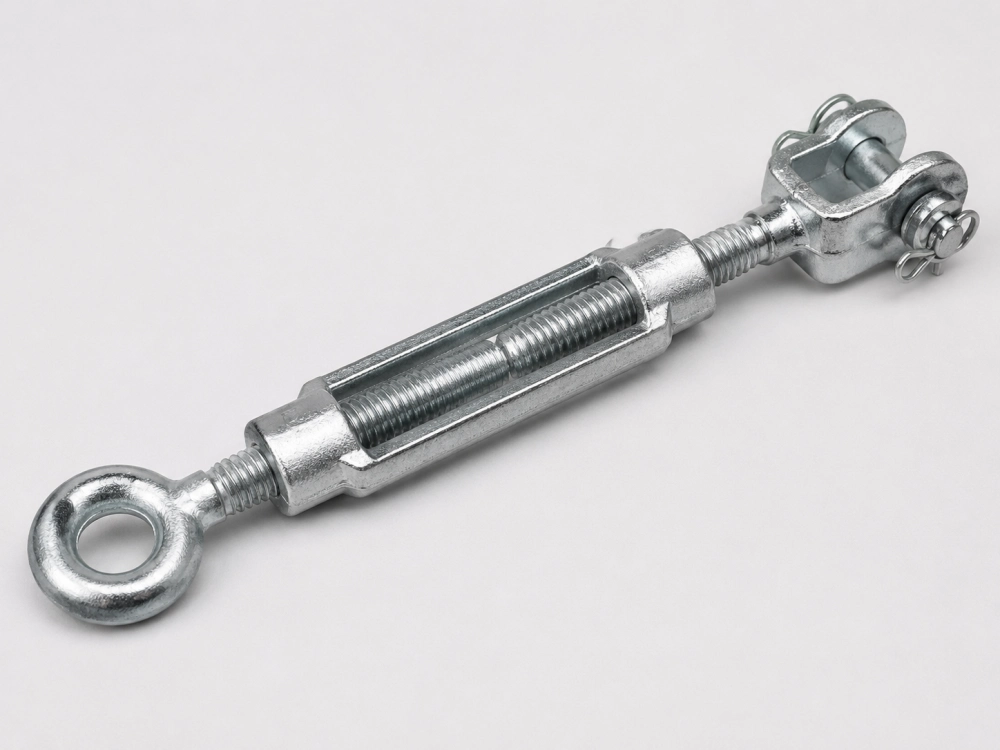
Formwork Turnbuckle Spacing and Load Calculation
Proper spacing of concrete turnbuckles is critical for form stability. The general formula for calculating turnbuckle spacing is:
Spacing (m) = WLL (kN) / (Form Pressure (kN/m²) × Height (m) × Safety Factor)
For a typical 3-meter wall pour using turnbuckles with a 25 kN WLL and an expected form pressure of 60 kN/m² at full liquid head, with a 2:1 safety factor:
Spacing = 25 / (60 × 3 × 2) = 0.069 m spacing vertically, which is impractically close. This highlights why formwork systems typically distribute load across multiple ties—the turnbuckle is one element in a larger engineered system. Consulting a formwork engineer for project-specific calculations is strongly recommended.
Concrete Turnbuckle vs. Standard Rigging Turnbuckle
While both share the turnbuckle mechanism, concrete formwork turnbuckles differ from standard rigging turnbuckles in several important ways.
| Feature | Concrete Turnbuckle | Standard Rigging Turnbuckle |
|---|---|---|
| Primary use | Formwork alignment & bracing | Tensioning wire rope & rigging assemblies |
| End fittings | Hook, threaded stud, flat plate | Jaw, eye, hook, stub |
| Body design | Long stroke with protective sleeve | Compact, open or closed body |
| Load direction | Compression + tension (brace mode) | Primarily tension |
| Adjustment mechanism | Welded cross-handle or hex drive | Open-end wrench or spanner |
| Corrosion priority | Concrete contact protection (sleeve/coating) | Environmental exposure (galvanized/SS) |
| Typical WLL range | 1.5–8.5 tons | 0.2–50+ tons |
Industry Applications
- Commercial building construction: Core walls, shear walls, elevator shafts, and basement retaining walls rely on formwork turnbuckles for dimensional accuracy.
- Civil infrastructure: Bridge abutments, retaining walls, culvert headwalls, and tunnel linings use heavy-duty bracing turnbuckles.
- Precast concrete plants: Magnetic and mechanical form systems in precast yards use turnbuckles to secure side forms and block-outs.
- Residential foundations: ICF (Insulated Concrete Form) bracing and standard foundation wall forms use lighter-duty turnbuckles.
- Tilt-up construction: Edge form alignment for tilt-up panels requires turnbuckles that resist both the pour pressure and panel lifting forces.
Maintenance and Inspection for Reusable Formwork Hardware
For contractors running multi-project formwork systems, turnbuckle maintenance directly impacts jobsite safety and hardware ROI. Implement these practices:
- Post-pour cleaning: Remove concrete splatter from threads immediately after stripping. Cured concrete in threads destroys the screw mechanism.
- Thread inspection: Check for galling, stripping, or deformation. A turnbuckle with damaged threads should be removed from service—even if the body appears intact.
- Lubrication: Apply form release oil or anti-seize compound to threads before each use. This prevents concrete bonding and reduces adjustment effort.
- Storage: Store clean and dry. Stacking wet turnbuckles accelerates corrosion. Use pallet racks or hanging storage where possible.
- Periodic load testing: For safety-critical applications, sample-test 5% of the fleet annually to verify WLL compliance.
Frequently Asked Questions
Can standard rigging turnbuckles be used for concrete formwork?
Not recommended. Standard rigging turnbuckles lack the protective thread sleeves needed for concrete contact, and their end fittings (jaw/eye) are not optimized for form panel attachment. Using the wrong hardware risks alignment failure and jobsite safety violations.
What is the typical lead time for concrete turnbuckles?
Standard galvanized concrete turnbuckles (M16–M24) are typically available from stock with 3–7 day lead times for quantities under 500 units. Custom sizes or stainless steel variants may require 2–4 weeks depending on the manufacturer’s production schedule.
How do I calculate the number of turnbuckles needed for a wall pour?
The required quantity depends on form panel dimensions, pour height, concrete mix design (affecting lateral pressure), and the turnbuckle WLL. A qualified formwork engineer should perform the calculation. As a rough estimate, budget one tie per 0.5–1.0 m² of form face for standard wall pours up to 4 meters.
Are concrete turnbuckles reusable across multiple projects?
Yes—this is one of their primary advantages. Hot-dip galvanized units typically deliver 3–5 years of service across multiple projects with proper cleaning and maintenance. Stainless steel units can last 15+ years, making them economical for contractors with sustained formwork operations despite higher upfront cost.
Source Your Concrete Turnbuckles from CraftMetal Works
At CraftMetal Works, we supply hot-dip galvanized and stainless steel concrete turnbuckles for formwork contractors, precast plants, and civil engineering projects. Our turnbuckles are manufactured to ISO 9001 quality standards with full material traceability and mill test certificates available on request.
We maintain inventory of standard M16, M20, and M24 sizes with hook, eye, and threaded stud end configurations. For custom specifications—including non-standard body lengths, special thread pitches, or project-specific packaging—contact our engineering team for a quotation within 24 hours.
Whether you need 50 units for a residential foundation or 5,000 for a multi-story commercial tower, we deliver consistent quality, competitive pricing, and reliable lead times. Browse our full industrial metal hardware catalog to explore related formwork accessories including tie rods, wing nuts, and anchor plates.