For rigging assemblies, marine tie-downs, suspension systems and architectural cable projects, the jaw and jaw turnbuckle is one of the most widely specified end-fitting configurations. Its two solid jaws pivot on threaded eye bolts, allowing in-line take-up and tensioning without twisting the cable or rod. This guide explains how jaw-jaw turnbuckles work, the load ratings, materials, common sizes, and the sourcing decisions an engineer or wholesale buyer should make before ordering.
If you need a turnbuckle that can be fitted or removed with a pin or clevis pin on both ends — and you don’t want a hook or closed eye — jaw-jaw is almost always the right choice. The open jaw lets a rigging technician drop the assembly onto a fixed pin without disassembling the cable termination.
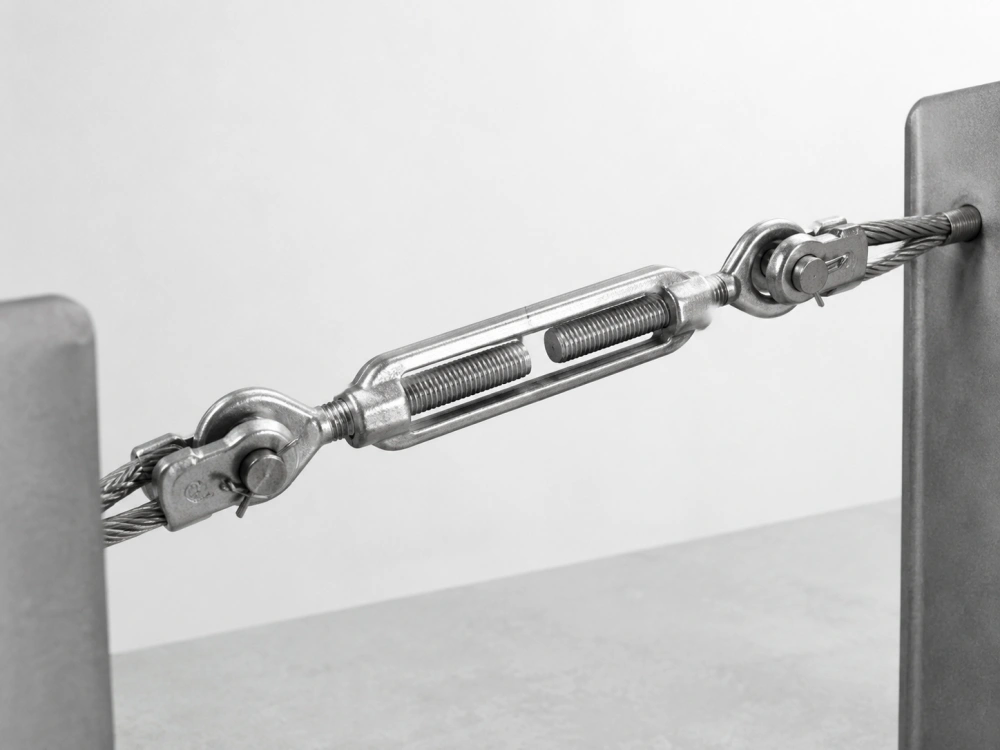
What Is a Jaw and Jaw Turnbuckle?
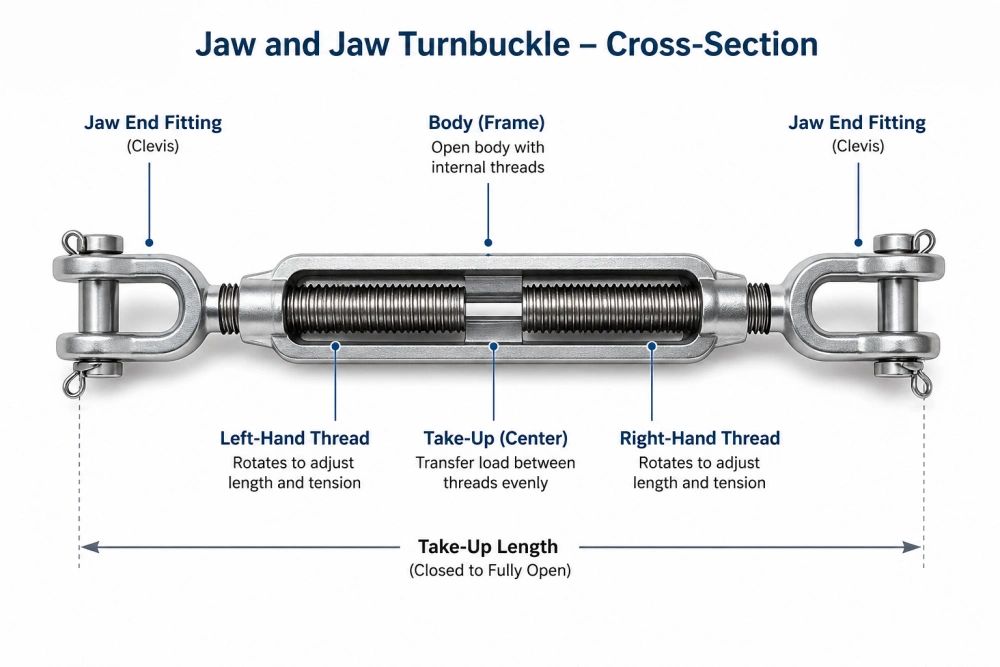
A jaw and jaw turnbuckle is a tensioning device with a jaw fitting (open clevis) on each end of the body. Each jaw has a hole that accepts a clevis pin, bolt, or shackle pin, allowing it to pivot freely when the turnbuckle body is rotated to take up or release tension.
It consists of three parts:
- Body (frame): An open hex or round frame with internal threads on both sides (one left-hand, one right-hand).
- Two end fittings: Each side has a solid jaw (a clevis-like fork) with a single pin hole.
- Threaded eye bolts or jaw bolts: In most jaw-jaw turnbuckles the eye bolts are integrated, so each end is a single jaw sub-assembly with its own internal thread.
Because the two ends are jaws — not hooks or closed eyes — the turnbuckle can be mated to any component with a fixed pin: pad eyes, D-rings, welded lugs, or the inner eye of a wire rope thimble assembly. This is why marine riggers, theatrical rigging crews, and structural cable contractors favor jaw-jaw configurations over hook and eye turnbuckles for permanent or safety-critical installations.
Jaw-Jaw vs Other Turnbuckle End Fittings
Turnbuckles are typically specified by the end fittings on each side. Choosing the right configuration is mainly about how the turnbuckle will attach to the rest of the assembly, the load direction, and whether the connection must be removable in the field.
| Configuration | End Fittings | Typical Use | Field Removable | Safety Margin |
|---|---|---|---|---|
| Jaw and Jaw | Open jaw / clevis fork on both ends | Marine rigging, structural cable, theatrical rigging | Yes (with clevis pin) | High — load is straight-pull only |
| Eye and Eye | Closed eye on both ends | Static guy wires, architectural cables | No (requires shackle) | High |
| Hook and Eye | Hook on one end, closed eye on the other | Light-duty tie-downs, quick release | Yes (snap on/off) | Low — hook can unclip under vibration |
| Hook and Hook | Hook on both ends | Cargo straps, light load binders | Yes | Lowest — not for overhead lifting |
For B2B buyers, the key practical difference is that jaw and jaw turnbuckles are the only configuration that combines a fully rated straight-pull load path with fast field assembly. Hooks are convenient but can straighten or unclip under shock load; eyes are strong but require a separate shackle to connect.
Common Materials and Finishes
Material selection for jaw-jaw turnbuckles depends on the environment. The frame and the jaw sub-assemblies must use the same alloy family to avoid galvanic corrosion at the threaded joint.
- Hot-dip galvanized carbon steel: The most common industrial grade. Used for general rigging, construction, and outdoor structural cable. Cost-effective and corrosion-resistant for most environments. Typical spec: ASTM A153 zinc coating over drop-forged steel body.
- Stainless steel (AISI 304 / AISI 316): Specified for marine, coastal, chemical and food-grade applications. AISI 316 is preferred for saltwater immersion. Used where the turnbuckle may be exposed to chlorides for long periods.
- Zinc-plated carbon steel: For indoor or dry-environment use where appearance matters. Thinner coating than hot-dip galvanizing — not suitable for permanent outdoor exposure.
- Black oxide / plain carbon steel: Lowest cost, indoor or temporary installations only.
For permanent outdoor rigging — sailboat stays, sign suspension, cable railing — stainless steel jaw and jaw turnbuckles offer the best long-term value despite higher unit cost, because they eliminate the maintenance cycle of re-galvanizing. For construction-site or temporary installations, hot-dip galvanized is usually specified because of cost and short-to-medium service life.
Standard Sizes and Load Ratings
Jaw and jaw turnbuckles are manufactured in thread diameters from roughly 1/4″ (M6) up to 1-1/2″ (M36) and beyond for heavy rigging. Working load limits (WLL) are typically rated at 25% of the breaking strength, in line with ASME B30.26 rigging hardware standards.
| Thread Diameter (in) | Thread Diameter (mm) | Typical WLL (lb) | Typical WLL (kg) | Common Use |
|---|---|---|---|---|
| 1/4″ | M6 | 500 | 227 | Light cable, signage |
| 5/16″ | M8 | 800 | 363 | Cable railing, small marine |
| 3/8″ | M10 | 1,200 | 544 | Marine stays, light structural |
| 1/2″ | M12 | 2,200 | 998 | Architectural cables, mid-rigging |
| 5/8″ | M16 | 3,500 | 1,588 | Heavy structural, boat rigging |
| 3/4″ | M20 | 5,200 | 2,359 | Industrial rigging, lift points |
| 1″ | M24 | 9,200 | 4,173 | Heavy marine, structural |
| 1-1/4″ | M30 | 14,500 | 6,577 | Bridge cables, large structural |
| 1-1/2″ | M36 | 21,000 | 9,525 | Infrastructure, heavy rigging |
These are typical working load limits for hot-dip galvanized carbon steel turnbuckles in commercial rigging service. Always check the manufacturer’s published rating for the specific part number and confirm the WLL applies to the end fitting, not just the body. Stainless steel jaw and jaw turnbuckles usually have similar or slightly lower WLL at the same thread size due to the lower tensile strength of the austenitic alloys.
How to Specify a Jaw and Jaw Turnbuckle
When sending an RFQ or PO to a turnbuckle manufacturer or wholesaler, the following information should always be included to avoid substitution errors:
- End fitting configuration: Jaw & jaw (JJ). If a mix is required (e.g. jaw & eye), specify explicitly.
- Thread diameter and pitch: In inches (e.g. 1/2″-13 UNC) or millimeters (e.g. M12 × 1.75).
- Body length (take-up): The total adjustable length range, closed to fully open.
- Material and finish: Galvanized, stainless 304, stainless 316, etc.
- Working load limit (WLL): Required minimum, in lb or kg.
- Pin hole diameter on each jaw: Must match the clevis pin or shackle pin it mates with.
- Compliance / marking: CE, ASME B30.26, manufacturer traceability mark.
Installation and Safety Best Practices
- Match the pin: Always use a correctly sized clevis pin or shackle pin — undersized pins bend, oversized pins create slop and uneven loading.
- Use locking pins or cotter pins: Vibration can walk a plain pin out of the jaw hole over time. Use a hitch pin, R-clip, or stainless cotter pin for any permanent or safety-critical installation.
- Don’t side-load the jaw: Jaws are designed for straight-pull loading. A sideways force reduces the working load by 50% or more and can bend the jaw fork.
- Never use hooks for overhead lifting: If the application is lifting, personnel support, or overhead suspension, choose jaw-jaw or eye-eye only — never hook variants.
- Inspect before each lift: Check for bent jaws, stretched threads, corrosion pitting, or distortion. Replace rather than repair any damaged turnbuckle.
Frequently Asked Questions
What is the difference between a jaw and jaw turnbuckle and a jaw and eye turnbuckle?
A jaw and jaw turnbuckle has open jaw fittings on both ends, which accept a clevis pin directly. A jaw and eye turnbuckle has a jaw on one end and a closed eye on the other, which requires a separate shackle to connect. JJ turnbuckles are faster to install and remove, while JE is preferred when one end connects to a fixed eye fitting.
Can a jaw and jaw turnbuckle be used for overhead lifting?
Yes — provided the turnbuckle is rated for the load (look for ASME B30.26 or equivalent compliance), the body and end fittings are in good condition, and the jaw pins are secured against movement. JJ turnbuckles are widely used in lifting slings, spreader beams, and overhead rigging because the load path is straight and the connection is positive.
What size jaw and jaw turnbuckle do I need?
Size selection depends on the working load limit, the thread diameter needed to fit your cable terminations, and the take-up range. A common starting point is to size the turnbuckle so its WLL is at least 1.5× to 2× the maximum working load in your assembly, and so the take-up length covers the expected adjustment range with margin.
Are stainless steel jaw and jaw turnbuckles stronger than galvanized?
Not necessarily. Galvanized carbon steel turnbuckles typically have a higher tensile strength than austenitic stainless steel of the same thread size, so their WLL is often slightly higher. The advantage of stainless is corrosion resistance, not raw strength. For maximum strength in a non-corrosive environment, galvanized is usually the better value.
Do you supply custom sizes or special finishes?
Yes. As a custom metal hardware manufacturer, CraftMetal Works offers jaw and jaw turnbuckles in non-standard thread sizes, custom take-up lengths, special alloys (including 2205 duplex stainless for marine), and customer-specified finishes. Contact our engineering team with your drawing or specification for a quotation.
Get a Quote on Jaw and Jaw Turnbuckles
CraftMetal Works manufactures and exports jaw and jaw turnbuckles in galvanized carbon steel, stainless steel 304, and stainless steel 316 — from 1/4″ to 1-1/2″ thread diameters, with full material traceability and mill cert options. Browse the full range of industrial metal hardware in our catalog or send your RFQ to our sales team for a competitive quotation within one business day.